
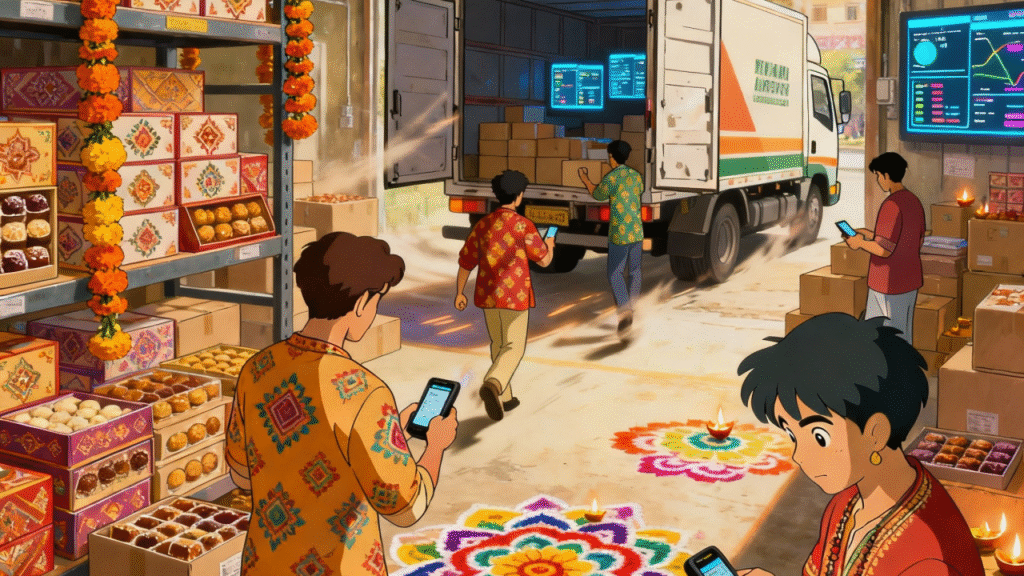
One of the biggest Diwali distribution challenges is the massive increase in counter sales. During the Diwali season, retailers experience heavy footfall and a sharp rise in transaction frequency. Traditional and manual distribution systems often struggle to keep up with this sudden surge in demand.
Another critical Diwali distribution challenge is the peak-hour inventory drain. High-demand FMCG products can go out of stock within just a few hours if the distribution network is not strong enough to handle rapid movement and replenishment.
Tight restocking windows further intensify Diwali distribution challenges. Retailers often have only overnight or same-day replenishment opportunities to prepare for the next day’s demand surge. Any delay in distribution can result in empty shelves and lost revenue.
Lastly, supply chain bottlenecks are among the most damaging Diwali distribution challenges. Inefficient distribution processes lead to delayed deliveries, poor stock visibility, and missed sales opportunities during the most profitable festive period of the year.
How Businesses Can Overcome Diwali Distribution Challenges
To overcome Diwali distribution challenges, businesses must focus on preventing sales loss at retail counters. An automated and responsive distribution system ensures shelves remain stocked throughout the festive rush, significantly reducing “out-of-stock” situations during peak hours.
Another key advantage in tackling Diwali distribution challenges is ensuring consistent product availability. With real-time visibility into inventory movement, businesses can track stock levels across all retail outlets and ensure timely deliveries before demand spikes.
Effectively managing both primary and secondary sales flow is essential to handle Diwali distribution challenges. A smart distribution system tracks product movement from the central warehouse to distributors (primary sales) and from distributors to retail counters (secondary sales), ensuring complete transparency across the supply chain.
Finally, addressing Diwali distribution challenges requires support for rapid replenishment. The ability to enable overnight inventory transfers and immediate next-day readiness helps retailers stay prepared for the next wave of festive demand without disruption.
Leveraging Customer Data and Engagement During Diwali
Identify fast-moving SKUs
Use POS and sales data to highlight products with spike in sales for priority restocking.
Track customer buying behavior
Analyze what customers are purchasing at peak hours to prepare future inventory.
Improve engagement with personalized offers
Distribution intelligence can enable targeted promotions and special deals for repeat buyers.
Forecast demand by geographic area
AI software can map local trends, sending higher stock to regions with sharp demand.
The Role of AI-Powered Distribution Software
An AI-based distribution platform transforms traditional supply chain operations, bringing scale, speed, and intelligence for Diwali’s intense shopping window.
Core Benefits
Automated inventory tracking
Monitors stock levels in real time across all channels and outlets.
Dynamic route optimization
AI selects fastest delivery routes for distributors, reducing turnaround time.
Demand prediction engine
Learns from ongoing sales data to forecast next-day and weekly demand surges.
End-to-end visibility
Provides complete insight into inventory and order status at every stage from warehouse to retail counter.
Rapid scaling during festive sales
Can handle thousands of concurrent delivery orders, stock transfers, and product allocations.
Parallel Capabilities
- Real-time communication with sales teams and distributors.
- Integration with invoicing, CRM, and ERP platforms.
- Automatic reordering triggers for fast-depleting SKUs.
- Geo-mapping for demand hotspots and targeted dispatch.
Making Primary & Secondary Sales Smoother
Primary sales:
AI system manages distribution from central warehouse to all regional distributors, ensuring stock penetration and timely deliveries.
Secondary sales:
Distributors use AI insights to quickly move inventory to retail counters, minimizing backorders and missed sales.
End result:
Both distribution links work fluidly, guaranteeing that shelves are stocked and customers served efficiently even at peak times.
Execution Plan for Retailers
Implement AI distribution software before festive rush
Begin integration and staff training in advance.
Link POS and inventory data
Connect sales counters to distribution intelligence for real-time alerts on stock-outs.
Run demand simulations
Use historic Diwali sales data to test and optimize AI predictions.
Monitor and adjust in real time
React swiftly to sales spikes; redistribute inventory immediately to high-performing counters.Logiangle
Conclusion
Diwali’s retail boom can overwhelm traditional supply chain systems, leading to lost sales, frustrated customers, and logistical chaos. By adopting AI-powered distribution software, retailers achieve a seamless flow from warehouse to retail counter, ensure products are always available, and gain the data-driven insights to keep both primary and secondary sales processes operating smoothly—even during the festive demand surge. The end result is greater revenue, stronger customer loyalty, and a competitive edge in India’s most critical shopping season.